6 tips for creating engaging content

When I first started creating content seriously, I thought “engaging content” meant making something beautiful, funny, or trendy enough that people would instantly care.
Over time, I learned that is only part of it.
The content that gets saved, shared, commented on, and remembered usually does something more specific. It helps people understand something, feel seen, make a decision, avoid a mistake, or say, “I need to send this to someone.”
That is the practical version of engaging content. It is not just content that looks good. It is content that gives your audience a reason to react.
If you are a creator, influencer, freelancer, or brand building online, the goal is not to post more for the sake of posting more. The goal is to create content your audience actually wants to spend time with.
1. Understand why people follow you
Before you create another post, Reel, TikTok, carousel, newsletter, or YouTube video, ask one simple question:
Why would someone follow me instead of scrolling past?
This sounds obvious, but it is where a lot of creators get stuck. They post based on what they feel like making that day, then wonder why the content feels random.
People usually follow creators for a reason. That reason might be:
- They learn something useful from you
- They like your taste or point of view
- They relate to your lifestyle
- They trust your recommendations
- They want to be entertained
- They want to improve at something
- They feel like you understand their problem
Once you know the reason people follow you, content becomes much easier to plan.
A fitness creator might be followed for realistic workout routines. A beauty creator might be followed for honest product reviews. A student creator might be followed for study systems and productivity ideas. A travel creator might be followed for itinerary inspiration, hotel finds, or behind-the-scenes planning.
The mistake is trying to be interesting to everyone. That usually makes your content too broad.
A better question is: what does my specific audience come to me for?
When you understand that, your content starts to feel more intentional. You know what topics to repeat, what examples to use, what questions to answer, and what kind of posts are worth turning into a series.
2. Create content around real audience problems
The easiest way to make content more engaging is to stop starting with “what should I post?” and start with “what is my audience trying to figure out?”
That shift changes everything.
Instead of posting “My morning routine,” a productivity creator could post “The morning routine I use when I know I only have 20 minutes.” Instead of posting “New skincare favorites,” a beauty creator could post “The products I would rebuy if my skin suddenly got dry.” Instead of posting “Brand deal tips,” a creator-business account could post “What I send when a brand asks for my rates.”
The second version is usually stronger because it gives the audience a clear reason to care.
Good content often starts from a question, frustration, goal, or tiny moment your audience already recognizes.
Examples:
- “Why are my Reels getting views but no followers?”
- “What should I include in a brand pitch?”
- “How do I price a sponsored post?”
- “Why is my content not getting saves?”
- “What should I post when I have no ideas?”
- “How do I make my content look more professional?”
These are not just content ideas. They are entry points into the reader’s head.
If you are not sure what your audience cares about, look at your comments, DMs, search queries, analytics, and the questions people ask in your niche. The answers are usually already there.
You can also use platform tools to spot patterns. For example, Instagram Insights can help you understand which posts people interact with, while TikTok Creative Center can help you see creative patterns and trends on TikTok.
The point is not to copy what everyone else is doing. The point is to understand what people are responding to, then bring your own perspective to it.

3. Make the first few seconds obvious
A lot of good content fails because the beginning is too slow.
This is especially true for short-form video, but it also applies to carousels, blog posts, emails, YouTube intros, and even captions.
People need to know quickly why they should keep watching or reading.
That does not mean every post needs a dramatic hook. It just means the opening should be clear.
Weak openings usually sound like this:
- “Hey guys, welcome back”
- “I wanted to come on here and talk about something”
- “Here are some thoughts I had today”
- “This is just a quick reminder”
Sometimes that works if your audience already loves you. But if you are trying to reach new people, it usually asks for too much patience.
Stronger openings are more specific:
- “If your Reels get views but no comments, check this first.”
- “Here is what I would change in this brand pitch.”
- “Three content ideas for creators who want brand deals.”
- “The mistake I made when I first started posting consistently.”
- “Save this before you send your next media kit.”
A good hook tells the audience what they are about to get.
For educational content, lead with the problem or outcome. For personal content, lead with the moment that makes the story worth hearing. For product or brand content, lead with the use case, not the product name.
This is also where simple language matters. If the audience has to work too hard to understand the first sentence, you have already lost part of them.
4. Use visuals that actually help the content
Visuals matter, but not every visual makes content better.
A pretty image can make someone stop for a second. A useful image can make them save the post.
That is the difference.
If you are creating educational content, use visuals to make the idea easier to understand. Show the before and after. Break down the process. Use screenshots, examples, annotations, charts, or simple layouts that help the reader follow the point.
If you are creating lifestyle content, use visuals to make the story feel real. Show the routine, the product in use, the messy middle, the setup, the result, or the small detail that makes the post feel specific.
If you are creating content for brand deals, visuals are even more important. Brands are not only looking at your reach. They are looking at how clearly you can communicate an idea.
A creator who can make a product feel natural inside useful content is much more valuable than a creator who only posts a polished product shot with a generic caption.
Good visuals can include:
- A step-by-step screenshot
- A simple checklist
- A before-and-after example
- A content calendar preview
- A comparison between two options
- A visual breakdown of a campaign result
- A creator setup or behind-the-scenes photo
- A product shown in a real use case
The key is that the visual should support the message. If it does not make the content clearer, more useful, or more memorable, it is probably just decoration.
5. Give people a reason to comment, save, or share
Engagement is not random. Most people engage because the content gives them a reason to.
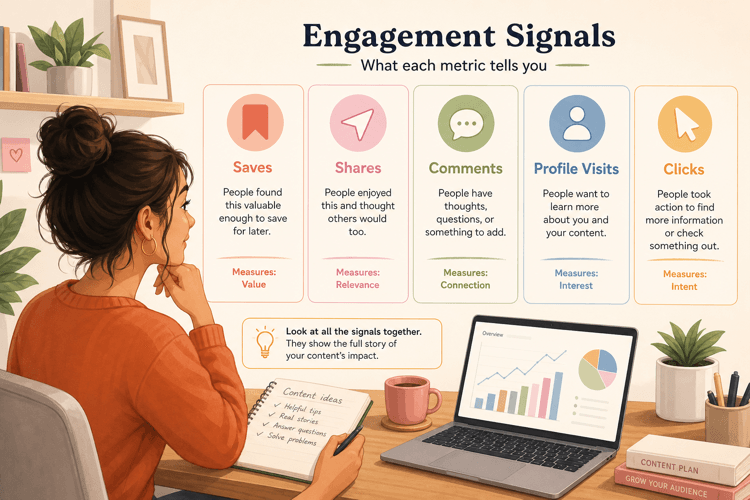
A comment usually happens when someone has an opinion, a question, an emotional reaction, or something to add.
A save usually happens when the content feels useful enough to come back to later.
A share usually happens when someone thinks, “This reminds me of a friend,” “My audience needs this,” or “This says what I have been thinking.”
So if you want more engagement, think about the type of action your content naturally supports.
For saves, create content that is useful later:
- Checklists
- Templates
- Step-by-step guides
- Scripts
- Mistakes to avoid
- Pricing reminders
- Caption formulas
- Content prompts
For shares, create content that feels relatable or clarifying:
- “Things creators learn after their first brand deal”
- “What brands think they are asking for vs. what creators hear”
- “Why your content feels inconsistent”
- “The difference between an audience and a community”
For comments, create space for a real response:
- Ask what people would do in a specific situation
- Invite people to share their experience
- Compare two options
- Share a take that people can agree or disagree with
- Ask a question that does not have one perfect answer
The best engagement prompts do not feel forced. They fit the content.
For example, if you post about pitching brands, a natural question might be: “What part of pitching feels hardest to you right now?” That will usually feel better than “Comment YES if you agree.”
If you want to track whether people are actually engaging with your content, use an Instagram engagement rate calculator or compare saves, shares, comments, and profile visits inside your platform analytics.
The goal is not to chase vanity metrics. The goal is to understand what your audience finds useful enough to act on.
6. Build a repeatable content system
Engaging content gets easier when you stop treating every post like a brand-new creative emergency.
Most strong creators have repeatable formats. They may not call them systems, but that is what they are.
A repeatable format could be:
- Weekly content audits
- “What I would do if…” posts
- Before-and-after breakdowns
- Mistakes creators make
- Brand pitch examples
- Monthly analytics lessons
- Product reviews using the same structure
- Behind-the-scenes campaign recaps
- Quick tutorials around one specific problem
Formats help because your audience knows what to expect, and you do not have to reinvent the structure every time.
This does not mean your content should feel repetitive. It means your thinking becomes easier to follow.
For example, a creator who teaches brand outreach could create a weekly “pitch review” format. One post could break down a weak subject line. Another could improve a pitch email. Another could explain what to attach. Another could show how to follow up without sounding pushy.
That is one content pillar with many angles.
If you want to work with brands, this also helps you look more professional. A clear content system shows that you understand your niche, your audience, and your creative process.
When you later build a portfolio or creator media kit, these repeated formats can become proof of what you create well.
What I would check before posting
Before publishing a piece of content, I would run it through a quick filter:
- Is the idea clear in the first few seconds?
- Does this help, entertain, explain, or make someone feel understood?
- Is there one main point, or am I trying to say too much?
- Would my target audience actually care about this?
- Is the visual helping the idea?
- Is there a natural reason to save, share, or comment?
- Does this fit the kind of creator or brand I want to become?
That last question matters more than people think.
Engaging content is not only about performance. It is also about positioning. Every post teaches your audience what to expect from you.
If you constantly post random trends, people may engage once but forget what you stand for. If you consistently post useful, specific, recognizable content, people start to understand why they should follow you.
Final thoughts
Creating engaging content is not about becoming louder, trendier, or more polished than everyone else.
It is about understanding your audience well enough to make content that feels useful, relevant, and worth reacting to.
Start with why people follow you. Build ideas around real problems. Make the opening clear. Use visuals that help. Give people a reason to engage. Then turn what works into repeatable formats.
That is how content starts to feel less random and more intentional.
And usually, that is when the right people start paying attention.
Create your media kit with CreatorsJet
Stand out from the competition with a professional media kit created with CreatorsJet. Share all your social media analytics with the click of a button.
🚀 Create your media kit in minutes
✅ Automatically updated
💬 Share with the click of a button
free forever, no credit card required.
